

When 5052 and 6061 aluminum sheet appear side-by-side on a quote—with similar price points and identical appearances—they often become the subject of heated debate among procurement teams. Some engineers, relying on habit, might swap a material for 6061-T6 aluminum, only to find the first batch cracking along the bend line. Others might switch a load-bearing frame to 5052 aluminum, only to realize it lacks the necessary strength, forcing a costly rework. The distinction between these two grades lies in their alloy composition and strengthening mechanisms—factors that directly impact the yield rate at every stage of the manufacturing process.
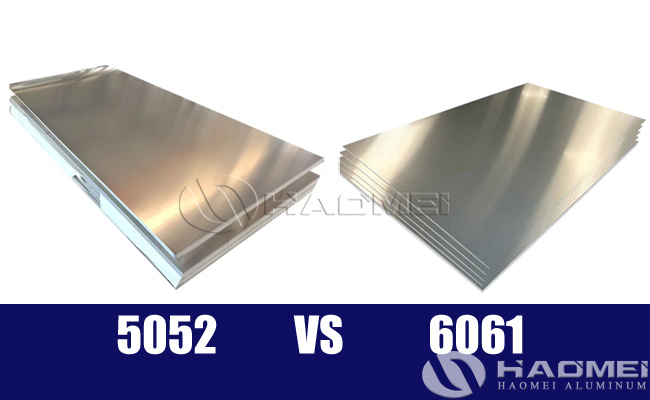
5052 aluminum belongs to the Al-Mg series (5xxx); its strength is derived from strain hardening (cold working), and it cannot be strengthened through heat treatment. 6061 aluminum belongs to the Al-Mg-Si series (6xxx) and achieves its T6 temper through solution treatment followed by artificial aging. The former prioritizes superior corrosion resistance and formability, while the latter offers a balance between strength and machinability. In engineering practice, the relevant comparison is typically between the two commonly used tempers: 5052-H32 and 6061-T6.
|
Parameter |
5052-H32 |
6061-T6 |
|
Alloy Series |
Al-Mg (5xxx) |
Al-Mg-Si (6xxx) |
|
Major Alloying Elements |
Mg 2.2–2.8%, Cr 0.15–0.35% |
Mg 0.8–1.2%, Si 0.4–0.8%, Cu 0.15–0.4% |
|
Strengthening Mechanism |
Strain hardening (cold working); non-heat-treatable |
Solution treatment + artificial aging; heat-treatable |
|
Common Tempers |
O, H32, H34, H38 |
O, T4, T6, T651 |
|
Tensile Strength |
210–260 MPa (typically ~230 MPa) |
290–310 MPa |
|
Yield Strength |
≥130 MPa (typically ~193 MPa) |
240–276 MPa |
|
Elongation |
≥12% |
~10% |
|
Brinell Hardness |
~60 HB |
~95 HB |
|
Density / Elastic Modulus |
2.68 g/cm³ / ~70 GPa |
2.70 g/cm³ / ~69 GPa |
- Bending/Forming:
For 5052-H32, the minimum internal bend radius is approximately 1x the sheet thickness; it performs well in rolling, deep drawing, and flanging operations. For 6061-T6, the bend radius must be increased to 2.5–3x the sheet thickness; otherwise, cracking may occur along the bend line. For complex shapes, it is recommended to perform forming in the O or T4 temper, followed by T6 aging.
- Welding:
5052 aluminum offers excellent weldability, retaining high strength after welding. For 6061-T6, the heat-affected zone (HAZ) reverts to a state approaching the T4 temper, with joint tensile strength dropping to approximately 60%–70% of the base metal; in such cases, if re-solutionizing and artificial aging are not feasible on-site, the cross-sectional area must be increased for reinforcement.
- Machining:
6061-T6 produces short, manageable chips and offers superior dimensional stability, making it the primary choice for CNC-machined parts, jigs, and mold backing plates. In contrast, 5052 tends to be "gummy" (tending to stick to the cutting tool), which complicates chip evacuation and the achievement of a high-quality surface finish.
- Corrosion Resistance:
Aluminum 5052 contains no copper, providing greater stability in salt spray, marine environments, and chemical processing conditions. 6061 contains copper; while it offers good corrosion resistance, it is generally inferior to 5052 in this regard.
- Surface Treatment:
Aluminum 6061 yields a uniform color and a bright, lustrous finish when anodized, making it ideal for decorative components and electronic enclosures. The anodic film on 5052 tends to appear grayish, making it better suited for functional, anti-corrosive applications.
Choose 5052 aluminum for: Sheet metal components requiring bending, rolling, or deep drawing; enclosures and cabinets; fuel tanks and storage vessels; marine and offshore equipment; applications exposed to humidity, salt spray, or chemical environments; and production lines utilizing continuous coil-fed stamping or leveling processes.
Choose 6061 aluminum for: Load-bearing structural components, equipment frames, precision CNC-machined parts, mold backing plates, and inspection fixtures—situations where high strength, dimensional stability, and high-quality decorative anodizing are required.
Evaluate costs based on the individual part, rather than just the price per ton. While 6061 has a higher unit cost, it generates less machining scrap and offers a higher yield of acceptable parts; conversely, while 5052 is cheaper as a raw material, it may require more labor hours during CNC machining.
Determine the required bend radii and the number of weld points before selecting the alloy grade. For structural components that require complex forming or feature numerous welds, 5052-H32 is generally a more convenient choice than 6061-T6.
When sourcing aluminum coils, pay attention to four key factors: thickness tolerance, flatness, inner coil diameter and total coil weight, and the specified temper. For 5052 coils, the H32 temper is the most versatile and commonly supplied option.
Comparing the two, the choice is straightforward: aluminum 5052 excels in forming, welding, and corrosion resistance, while aluminum 6061 is superior in terms of strength, machinability, and suitability for anodizing or decorative finishes. When selecting a material, consider whether the part requires bending, involves a high density of welds, or will be exposed to humid or salt-spray environments—these factors largely dictate the appropriate alloy. If your application demands high-precision machining and dimensional stability, 6061-T6 is the better fit; conversely, for continuous stamping production lines using coils, 5052-H32 is the preferred choice.
About Us
| News
| Products
| Download
| Contact Us
Haomei Aluminum is a large-scale listed company in China, which is engaged in the processing of aluminum sheet, aluminum coil, aluminum strip, aluminum circle and aluminum foil. With an annual capacity of 200,000 tons, Haomei Aluminum provides varieties of aluminum products to more than 30 countries in the world.
Address: No.14 Waihuan Road, New district, Zhengzhou, China.


