

Mill finish aluminum sheets are aluminum sheets that have been rolled without any subsequent surface treatment, retaining their original rolled state. They are also commonly referred to as plain aluminum sheets or natural smooth aluminum sheets. As the most basic delivery form in the aluminum industry, it is both the upstream substrate for the vast majority of surface-treated aluminum sheets and a general-purpose aluminum material category with extremely high demand in industrial manufacturing and engineering support fields. With its stable performance, outstanding cost-effectiveness, and strong adaptability to secondary processing, it occupies a fundamental and core category position in the global aluminum export trade.
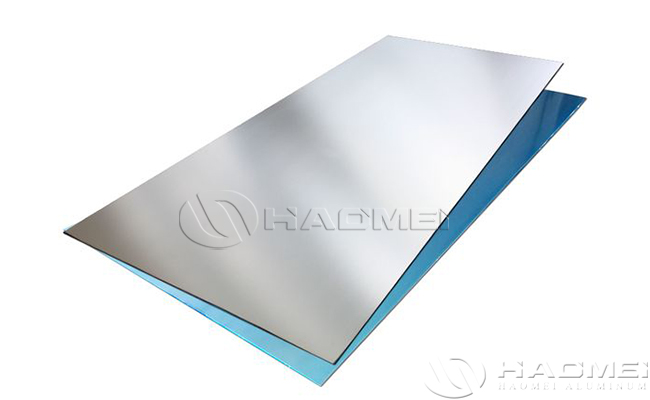
The surface condition of mill finish aluminum sheets is entirely determined by the rolling process. Different rolling paths correspond to different surface precision and physical properties. Cold-rolled mill finish aluminum sheets have a fine and smooth surface, with a roughness typically controlled within Ra 0.2~1.6μm. The sheet surface has a uniform rolling texture and a thin protective rolling oil film, resulting in higher thickness precision. The thickness tolerance of a standard 1.0mm sheet can be controlled within ±0.05mm, conforming to the ASTM B209 international standard. Hot-rolled mill finish aluminum sheets have a relatively rough surface, with a roughness of approximately Ra 1.6~6.3μm. This results in more uniform internal stress, making them more suitable for thicker structural components and subsequent heat treatment. The two types of products cater to different downstream processing needs.
Mill finish aluminum sheets cover the full range of mainstream aluminum alloy systems, meeting the performance requirements of most industrial and architectural applications.
For general corrosion resistance, electrical conductivity, and thermal conductivity applications, 1060 and 1100 pure aluminum series are commonly used;
For routine bending and rust prevention, 3003 and 3004 aluminum-manganese alloys are used;
For medium-to-high strength and salt spray resistance requirements, 5052 and 5083 aluminum-magnesium alloys are suitable;
For heat treatment strengthening applications, 6061 and 6063 alloys are chosen, balancing strength and machinability.
In terms of specifications, cold-rolled thin plates range in thickness from 0.2mm to 6.0mm, while hot-rolled thick plates range from 6.0mm to 200mm. Standard flat plate sizes include 1220×2440mm and 1500×3000mm, and custom cutting and leveling are supported. Coil delivery is also available.
The core value of mill finished aluminum sheets lies in maximizing cost control while preserving the original properties of aluminum, and they possess excellent adaptability for secondary processing. Since no additional surface treatment is required, the procurement cost is 15% to 30% lower than that of sprayed or anodized aluminum sheets of the same material and specifications, making it the preferred substrate for downstream deep-processing enterprises. It can be directly subjected to subsequent surface treatments such as anodizing, fluorocarbon spraying, powder coating, wire drawing, and film coating. Simultaneously, it can be directly used in industrial scenarios where decorative appearance is not required, such as equipment linings, pipe insulation shells, tank enclosures, industrial structural components, and automotive parts stamping blanks. It can also be used as cladding material for concealed parts in building construction.
The core quality standards for high-quality mill finish aluminum sheets focus on three dimensions: sheet shape accuracy, surface consistency, and performance stability. When selecting sheet materials, it's necessary to differentiate between hot-rolled and cold-rolled products based on processing requirements: cold-rolled thin sheets are preferred for bending, stamping, and surface oxidation treatments, while hot-rolled thick sheets are chosen for structural load-bearing and heat treatment processes. Quality requirements include a surface free of obvious scratches, indentations, and color differences; a uniform and intact rolling oil film to prevent oxidation during transportation and storage; a flatness deviation of ≤0.5mm/m; and a camber controlled within 2mm per meter to ensure stable feeding for subsequent automated processing.
As a professional aluminum exporter, our entire range of mill finish aluminum sheets is manufactured in strict accordance with international standards such as ASTM and EN, covering mainstream alloys from 1xxx series to 6xxx series and all thickness specifications. Sheet shapes are precise, tolerances are stable, and each batch comes with a complete material testing report and certificate of origin. For export shipping scenarios, we use moisture-proof film and reinforced wooden pallets to prevent oxidation and deformation during sea transport. We support custom sizes and small-batch trial orders, and can provide stable and reliable basic aluminum material supply services to global deep processing customers and engineering contractors.
About Us
| News
| Products
| Download
| Contact Us
Haomei Aluminum is a large-scale listed company in China, which is engaged in the processing of aluminum sheet, aluminum coil, aluminum strip, aluminum circle and aluminum foil. With an annual capacity of 200,000 tons, Haomei Aluminum provides varieties of aluminum products to more than 30 countries in the world.
Address: No.14 Waihuan Road, New district, Zhengzhou, China.


